
Guide to Vedic Astrology Houses and Your Life
A birth chart can feel intensely personal because it is not simply describing personality. It maps the areas of life where your soul contracts, talents, pressures, and recurring lessons tend to surface. This guide to Vedic astrology houses helps you read that map with more precision, especially when you are trying to understand why one part of life feels effortless while another asks for deeper work.
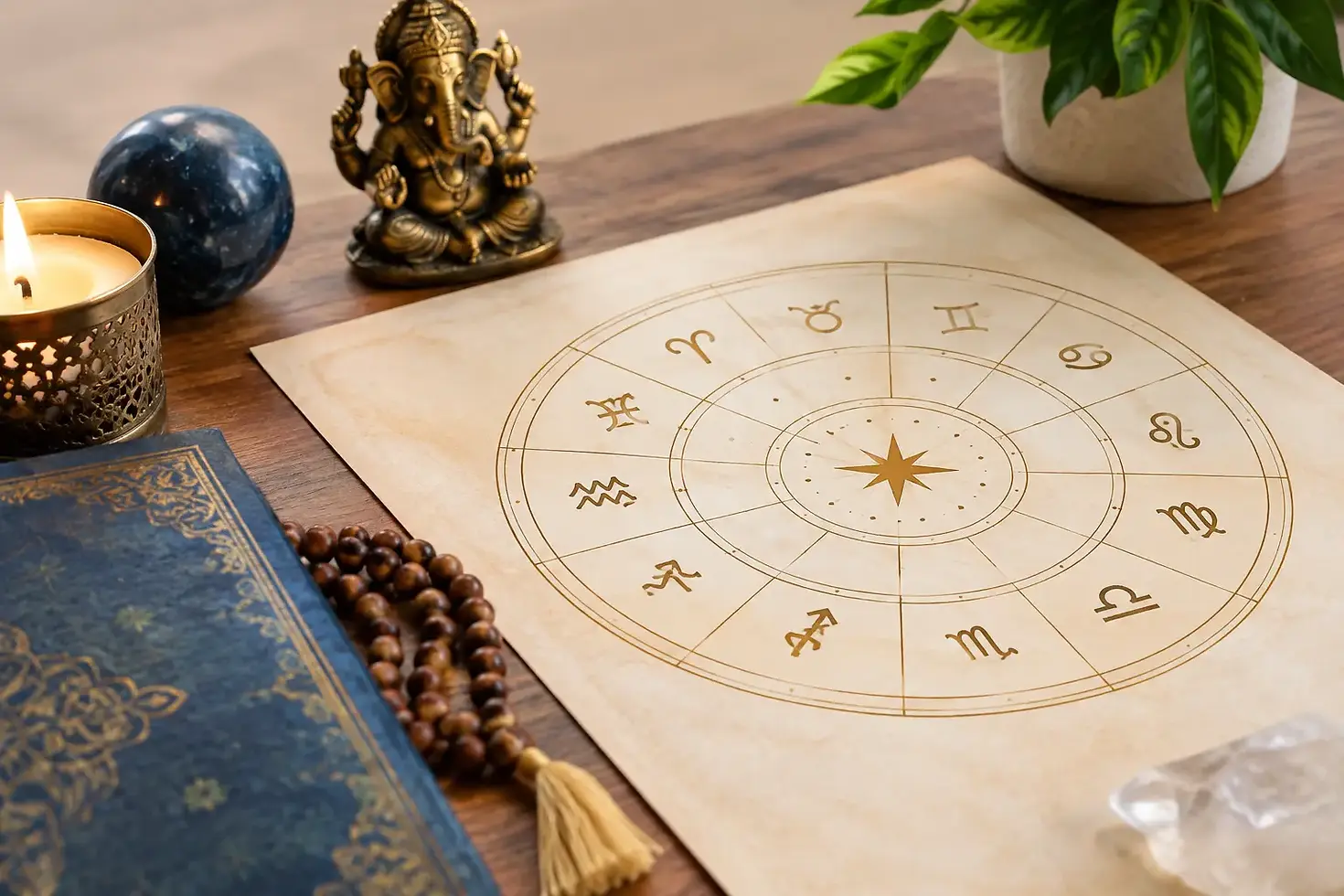
In Vedic astrology, the 12 houses are called bhavas. Each house governs a distinct life arena, from identity and resources to partnership, career, spirituality, and liberation. The planets show what energy is active. The zodiac signs show how that energy expresses itself. The houses show where the story unfolds.
That distinction matters. A difficult relationship pattern, career plateau, or period of emotional exhaustion is rarely explained by one placement alone. Your rising sign, house lords, planetary aspects, dashas, and transits all shape the larger karmic pattern.
How Vedic Astrology Houses Work
The first house begins with your ascendant, also called the Lagna. Unlike a sun-sign horoscope, a Vedic chart is organized around the exact sign rising on the eastern horizon at your moment of birth. This is why an accurate birth time is essential. A shift of minutes can sometimes change house placements, timing interpretations, and the emphasis of your life path.
Vedic astrology typically uses the whole-sign house system. Once the ascendant is established, the entire rising sign becomes the first house, and each following sign fills the next house. This creates a clean structural sequence that makes it easier to trace the connections between life areas.
For example, if a planet sits in the 10th house, it may influence public work, vocation, responsibility, or reputation. But whether that influence feels supportive, demanding, visible, delayed, or transformative depends on the planet involved, its strength, the sign it occupies, and the condition of the 10th-house ruler.
A Guide to Vedic Astrology Houses: The 12 Life Arenas
Houses 1 Through 4: Identity, Resources, Communication, Roots
The first house is your embodied identity. It speaks to vitality, appearance, temperament, confidence, and the way you initiate life. It is the doorway into the entire chart. When you feel disconnected from who you are becoming, the first house often holds important clues.
The second house relates to money, possessions, values, family conditioning, food, and speech. It shows not only what you earn, but how safe you feel receiving and sustaining resources. Repeating financial stress can involve second-house themes, though it should never be reduced to astrology alone. Practical habits, opportunity, and support systems matter too.
The third house governs communication, learning, courage, siblings, local movement, and consistent effort. This is less about dramatic destiny and more about the small actions that build momentum. Strong third-house patterns can point to writing, teaching, sales, entrepreneurship, or a path that asks you to develop your voice.
The fourth house is your inner foundation. It covers home, family roots, emotional security, mother figures, property, and private life. A career can look successful externally while the fourth house reveals a need for rest, belonging, or a home environment that actually restores you.
Houses 5 Through 8: Creativity, Service, Partnership, Transformation
The fifth house holds creative intelligence, romance, children, self-expression, joy, and the merit carried from prior efforts. In Vedic thought, it can also reveal how naturally you access inspiration. If you have been treating creativity as a luxury, your fifth house may remind you that it is part of your dharmic expression.
The sixth house concerns work routines, health practices, conflict, debt, obligations, and service. It can indicate where discipline is required. This house is often misunderstood as negative, yet it also shows your capacity to solve problems, build resilience, and become highly skilled through repetition.
The seventh house governs committed partnership, contracts, clients, and the people who meet you face-to-face. It reveals what you seek in close connection and what relationships mirror back to you. A challenging seventh house does not mean you are destined for loneliness. It may mean that partnership is a major classroom for boundaries, reciprocity, and mature choice.
The eighth house is one of the chart’s deepest chambers. It speaks to intimacy, shared finances, grief, crisis, taboo subjects, psychological change, inheritance, and hidden power. Eighth-house periods can feel like an ending, but they often ask you to release a version of yourself that can no longer carry your next chapter.
Houses 9 Through 12: Purpose, Calling, Community, Liberation
The ninth house relates to higher learning, spiritual beliefs, mentors, long-distance travel, ethics, and fortune. It is closely tied to dharma - the principles and direction that give your life meaning. When this house is activated, you may feel pulled to study, teach, travel, or question inherited beliefs.
The 10th house is your visible contribution. It covers career, leadership, achievement, status, responsibility, and the impact you make in the world. It is not limited to a job title. For some people, a powerful 10th house points toward entrepreneurship or public recognition. For others, it points toward becoming the dependable authority within a quieter field.
The 11th house governs networks, audience, friendships, long-range goals, income from career, and gains. It reveals how community can expand your opportunities. If you have been trying to build a future alone, this house asks a practical question: who is already aligned with the work you are here to do?
The 12th house represents rest, solitude, dreams, spirituality, retreat, foreign places, unconscious patterns, and release. It is associated with liberation from ego-based attachment. A strong 12th house may draw someone toward healing work, art, research, spiritual practice, or behind-the-scenes service. It can also signal the need to protect your energy and create meaningful space away from constant output.
Read the Houses as a Connected System
The most useful interpretations come from seeing the houses in relationship to one another. The second house of income, for instance, is linked to the 11th house of gains. The fourth house of inner security sits opposite the 10th house of public ambition. The first house of self is directly across from the seventh house of partnership.
These axes reveal trade-offs. An intense focus on achievement may strain your need for private restoration. A desire for partnership may ask you to strengthen your individual identity first. A period of financial growth may require clearer boundaries around overgiving or undercharging.
This is where generic astrology tends to stop too early. A planet in a house is not a fixed verdict. It is a pattern of potential that becomes more or less visible during specific planetary timing cycles, known as dashas, and through major transits. The chart describes tendencies. Your awareness, choices, relationships, and circumstances shape how those tendencies are lived.
Use Your House Placements for Grounded Reflection
Start with the first, fourth, seventh, and 10th houses. Together, they form a foundational cross: self, emotional roots, relationships, and life direction. Notice which of these areas feels active, delayed, unsettled, or ready for a new commitment.
Then look at the house connected to your immediate question. If career feels unclear, study the 10th house and its ruling planet. If relationship patterns repeat, examine the seventh house alongside the fifth house of romance and the eighth house of intimacy. If burnout keeps returning, the sixth and 12th houses may reveal the tension between obligation and restoration.
A personalized reading can bring the full architecture into focus by connecting your house placements with planetary strength, karmic mathematics, and current timing windows. At Karmic Soul Map, this layered approach is designed to turn symbolic information into clear reflection and aligned next steps, rather than another vague prediction.
Your chart is not asking you to fear the houses that feel difficult. It is asking you to meet each life area with greater honesty. The house that carries your greatest friction may also be the place where your soul develops its most enduring wisdom.



Comments